Dear Friends,
We’re already 50 days into 2024, but I have been so busy trying to do my best with many commitments that I’m only now finally finding time to publish my first blog post of this year. As I met up with lots of Chess friends in recent days during the school holiday, it’s a pleasure to now share many happy moments via nice photos 😊❤️😊


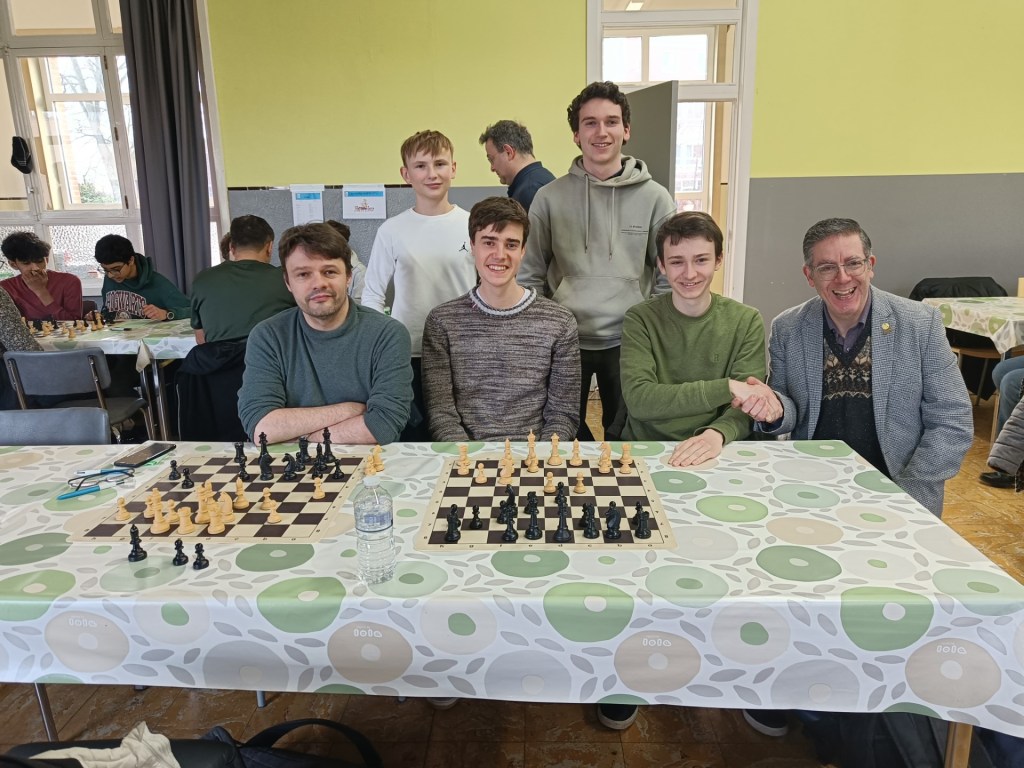


Time for a quick, wee Chess joke…!!
What’s the first name of a brilliant Belgian Chess player who can be as good as a Woman International Master!?
Answer: Wim!
P.S. If you see me with a black/blue bruise soon, you’ll know my joke backfired!! 😂

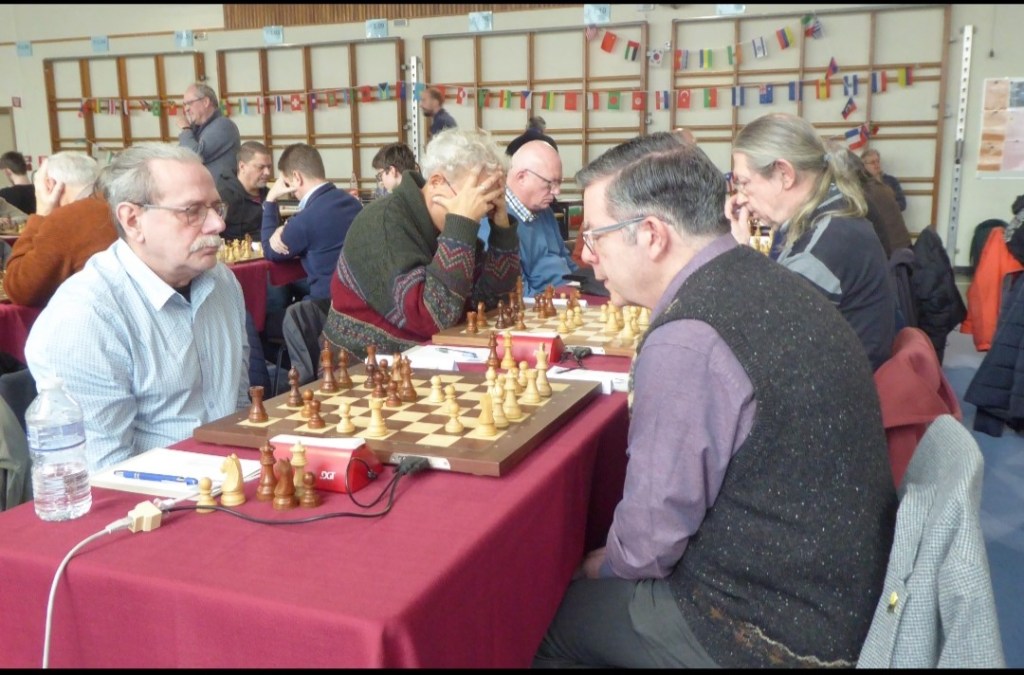

To do well in Mathematics or Chess it’s essential to practise a lot, and that requires precious time and great dedication.
I will now share with you an original Maths brainteaser which I created to celebrate the birthday of a friend named Eric who was turning 66 earlier this month…
I sent this on 9 February:

“Suppose that the Quadratic Equation x2 + bx + c = 0
has two positive whole number solutions for x.
In honour of Eric’s birthday on 12 February, we’ll say that c – b = 122.
Your Prize Puzzle Challenge now is to solve the equation x2 + bx + c = 0.
Please feel free to send me your two solutions for x by 12 February 👍😊
Wishing you lots of fun and happy solving,
Paul/Mr. M😊.”
Eric used EXCEL to solve the puzzle, which was OK as it was for his birthday, after all!! 😂
In general, though, I always hope that some people will send in a beautiful analytical solution worked out by themselves.
Warm congratulations to 14-year-old Wonderful Wout Callens who did solve the puzzle and sent me this, for which I will be delighted to present him with a nice prize in school this week:
“Dear Mr. Mo,
These are the steps I used to solve the problem:
c-b = 122 so c = b+122.
As the solutions are required to be positive whole numbers, we can derive from the quadratic formula that b<0 and that √(b2 – 4ac) must be a whole number.
We know that a=1 and that c=b+122 and substituting that into the square root and rearranging the expression, we get that √((b-2)2 -492) must be a whole number.
Then I tried out values for b for which √((b-2)2 -492) was equal to a whole number and found the values b=-42 or 46, but as b<0, b =-42.
Hence c=122-42=80.
Substituting a=1, b=-42 and c=80 into the quadratic equation, we get that x equals either 2 or 40.
Enjoy your holidays 😊
Wout.”
Thank you and congratulations again, dear Wout! 👍😊
I wrote personally to Eric on his birthday to say,
Dear Eric,
Happy birthday!! Have a really wonderful time!
Congratulations on finding that x = 2 or 40 in the puzzle I sent on Friday.
In this New Year ’24, add up 24 + 2 + 40 to get a nice total for your birthday!!!
With kindest wishes as always to your whole family,
Paul 😊.

Now, keen young or older fans of Mathematics could be interested to learn that there actually exists a super-fast method for solving the puzzle in a matter of seconds without even needing a calculator, and without even needing to figure out the individual values of b or c!! First, I will present a quick piece of theory which helps to crack the puzzle speedily👌
Suppose that the solutions to the quadratic equation x2 + bx + c = 0 are x = p or x = q. Then (x-p)(x-q) = 0, which leads us to x2-(p+q)x + pq = 0. Comparing coefficients in the quadratic equations can help us to realise that p+q = -b and pq=c. (Note: Those results can also be proved using the Quadratic Formula.) So, c-b = pq+p+q. Next comes a highly noteworthy mathematical trick… c-b+1 = pq+p+q+1 which factorises to (p+1)(q+1).
In the specific case we had where c-b = 122, we get that c – b + 1 = 123, and so (p+1)(q+1) = 123 = 3 x 41 (or 1 x 123). Therefore, since the puzzle required that p & q had to be positive whole numbers, it follows that p+1 = 3 & q+1 = 41 (or vice-versa), and p=2 & q=40 (or vice-versa). 💕
Those positive solutions are unique, but having a different value for c-b such as 2 would mean that c-b+1 = 3 which is 1 x 3 for (p+1)(q+1), and then we wouldn’t be able to get positive solutions for both p & q. Also, a different value for c-b such as 23 would mean that c-b+1 = 24 which is (1 x 24 or) 2 x 12 or 3 x 8 or 4 x 6 for (p+1)(q+1), and we would consequently get several possible pairs of values for p & q (unless we were to pin down specific individual values for b & c rather than just saying what value c-b has).
Quick Word Puzzle:
Rearrange the letters of RETRIED to make another proper seven-letter word also beginning with R.

Valère De Buck was rightly very pleased to discover a beautiful finish as White (to play and win) in a lovely game of his in Wachtebeke.
Valère calculated 1 fxe4 fxe4 2 Qg4+ and then 2…Kf6 3 Rf1+ or 2…Qf5 3 Rxe4+ Kf6 4 Rf7+ or 2…Kxd6 3 Bf4+! gxf4 4 Qxg6+ or 3…Kc6 4 Rc7#, checkmate! ❤️
Solution to Word Puzzle (given earlier, above):
RETIRED
I will round off this article with the following message:

With kindest wishes as always,
Paul M😊twani ❤️

 Paul Motwani
Hello Mr Mo
To be fair, I was impressed but also flattered by your comments on the chesshappening in Wachtebeke. Normally the senior category gets little attention in tournament reports afterwards but this time it is different! Thank you for that, Paul. Congratulations again on your perfect score of 6 out of 6, it is always difficult to get a maximum in any category. We are also very pleased with the nice photos and the attention paid to the achievements of the Ghent trio Wim, Valère and myself, despite the fact that you gave all three of us a hefty chess lesson 😉😉😉
Hope to see you in Blankenberge!
Greetings from Johan
LikeLiked by 1 person
Dear Johan,
Thank you for your really kind message, which is greatly appreciated 😊
I may well play in Blankenberge in April (God-willing as always), and in the meantime I’m sending warm greetings to you and all of our mutual Chess friends.
With sincere thanks again,
Paul 💖
LikeLike